
India’s Digital Landscape 2026 — Trends, Insights, and Growth Opportunities
Navigating India’s 2026 Digital Wave
I’ve been tracking India’s digital evolution since 2009—back when getting a client to even consider SEO was like pulling teeth. Fast forward to 2026, and I’m watching something I honestly never thought I’d see this quickly: India just crossed 1 billion internet users. Let that sink in for a moment.
The latest Digital 2026 India report from DataReportal confirms what those of us in the trenches have been feeling: this isn’t incremental growth anymore. With 1.03 billion Indians now online (70% penetration) and a year-over-year surge of 223 million new users—that’s a 27.7% jump—we’re witnessing a fundamental reshaping of how business gets done in this country.
Yet, 440 million Indians still aren’t online. That’s more than the entire population of the United States sitting on the sidelines. The opportunity is staggering, but so are the challenges of reaching them.
Over the past 14 years working with brands from Everyday Health to homegrown Indian startups, I’ve learned this: the companies that will dominate the next phase of India’s digital story won’t be the ones with the biggest budgets, they’ll be the ones who truly understand the nuances of this market. The urban-rural divide. The vernacular imperative. The mobile-only reality. The trust dynamics that make or break campaigns.
So let me walk you through what the data actually tells us and more importantly, what it means if you’re building a digital strategy for India in 2026 and beyond. I’ll share some real campaign insights, call out what’s working (and what’s overhyped), and give you the straight talk on where the smart money should be going.
The Numbers That Actually Matter
Internet Penetration: The 70% Milestone
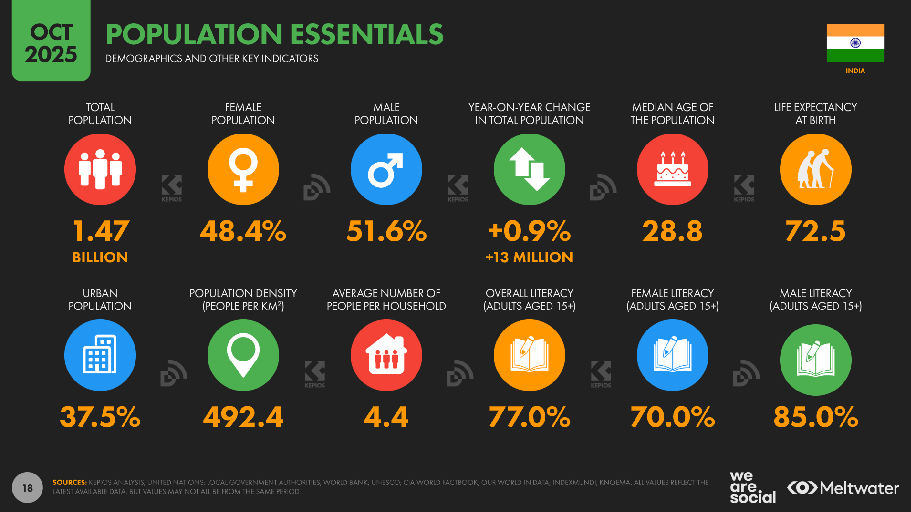
Let’s start with the headline figure. India reached 70% internet penetration in October 2025 that’s1.03 billion users out of a total population of 1.47 billion.
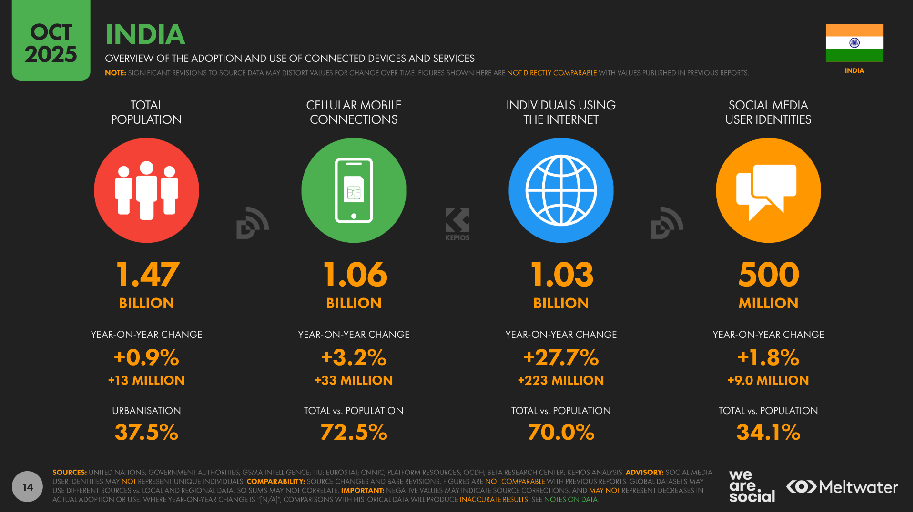
But here’s what the percentage doesn’t capture: we added more internet users in a single year than the entire population of Brazil. Think about the infrastructure, the behavior shifts, the market dynamics changing in real-time. I’ve run campaigns where our audience profile literally changed month-to-month because millions of first-time internet users were flooding onto platforms.
Take Meesho, for example the social commerce platform that’s absolutely crushing it right now. They don’t just translate their app into Hindi, but make it available in almost 10 different regional languages. They redesigned the entire user experience for people who’ve never shopped online before, who don’t have credit cards, who are navigating a smartphone for the first time. Their growth in tier-2 and tier-3 cities? Directly tied to understanding that these 223 million new users aren’t digital natives they’re digital immigrants, and they need hand-holding.
Mobile: The Only Screen That Matters
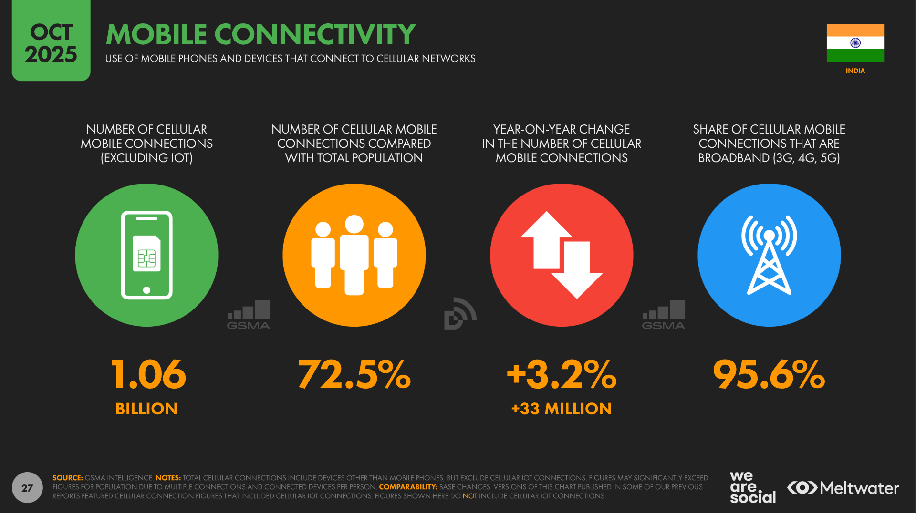
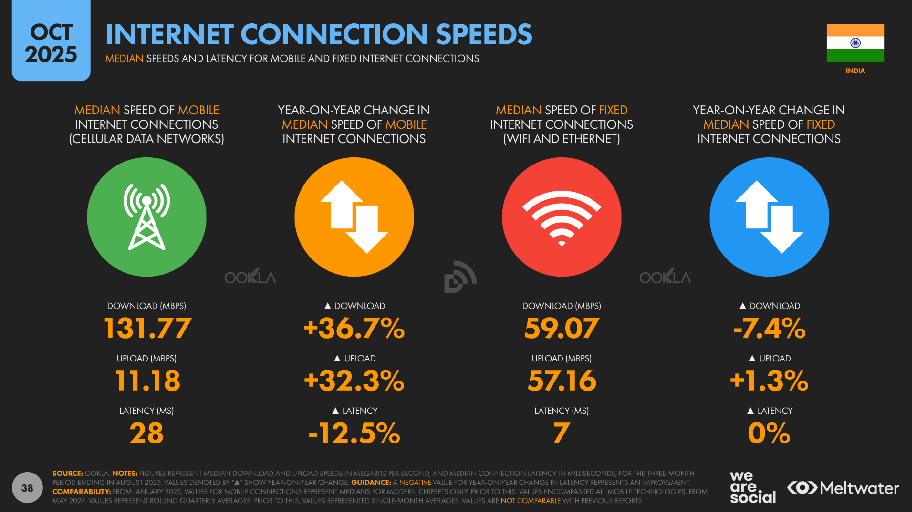
The report shows 1.06 billion mobile connections (72.5% of the population), with 95.6% being broadband-enabled via 3G/4G/5G networks. But the stat that should really grab your attention: median mobile download speeds hit 131.77 Mbps—up 36.7% year-over-year, according to Ookla’s data.
That’s faster than most home WiFi connections in developed markets. And it fundamentally changes what kind of experiences you can deliver on mobile.
Case in point: when I was optimizing page speed for a D2C beauty brand last year, we discovered that 87% of their traffic came from mobile, but their conversion rate was abysmal. Why? Their product pages were designed for desktop, with massive high-res images that took 8-10 seconds to load even on 4G. We rebuilt the entire mobile experience with vertical imagery, lazy loading, thumb-friendly CTAs and conversion jumped 43% in six weeks.
Here’s the reality: in India, “mobile-first” is a polite fiction. It’s mobile-only for the majority of your audience. If your site or app doesn’t work flawlessly on a mid-range Android phone on a spotty 4G connection, you’re leaving money on the table. Period.
Social Media: The 500 Million User Ecosystem
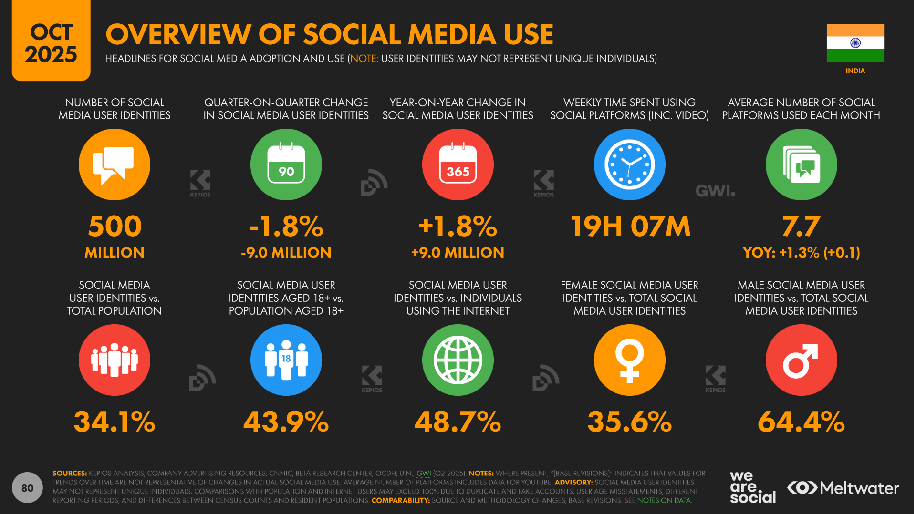
India now has 500 million social media users (34.1% of the population), per Kepios’s proprietary analysis. Among adults 18+, that jumps to 43.9% penetration. The growth rate has moderated to 1.8% year-over-year (9 million new users) which actually makes sense. We’re past the explosive early adoption phase and into the steady expansion phase. What’s fascinating: 48.7% of all internet users are on at least one social platform. That means roughly half of people getting online are engaging socially, creating content, building communities. For marketers, this is goldmine, but only if you know where to show up and what to say.
The Demographics That Define Digital India
Young, Ambitious, and Digitally Savvy
With a median age of just 28.8 years (per United Nations data), India is fundamentally a young country. Look at the age breakdown: 29.1% of the population is under 18, and another 29.1% falls between 18-34. These cohorts didn’t gradually adopt digital they grew up with it.
I saw this firsthand working with a fintech startup targeting millennials and Gen Z. Their assumption was that younger users wanted slick, minimal interfaces. Wrong. What actually converted? Content that spoke to specific life stages, paying for college, landing that first job, buying a bike, planning a wedding. The 25-34 age group (16.8% of the population) responded gangbusters to financial planning content tied to these milestones.
The younger segments 13-17 (8.6%) and even 5-12 (13.0%) are tomorrow’s consumers, but they’re influencing purchase decisions today. How many times have you seen a kid teaching their parents how to use UPI payments or install an app? Reverse mentoring is a real phenomenon in Indian households, and smart brands are designing experiences that empower these young digital natives to bring their families along.
The Gender Gap: Our Biggest Untapped Market
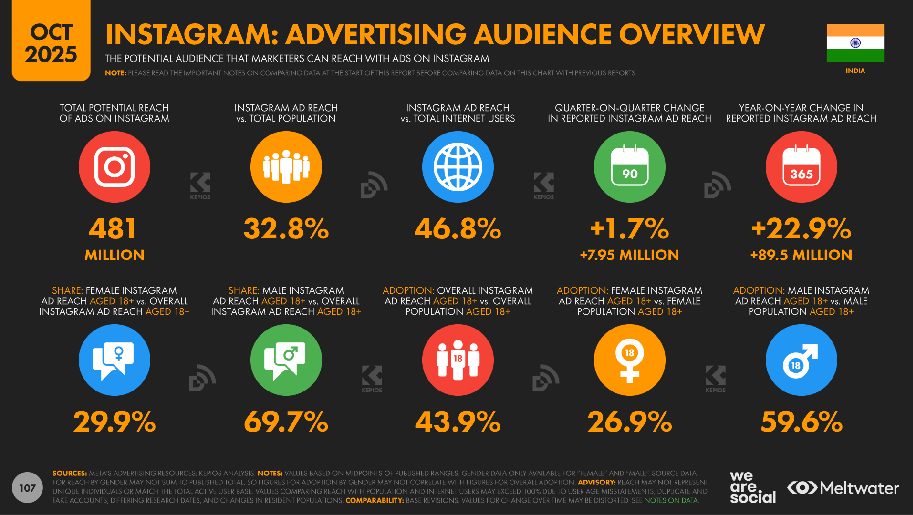
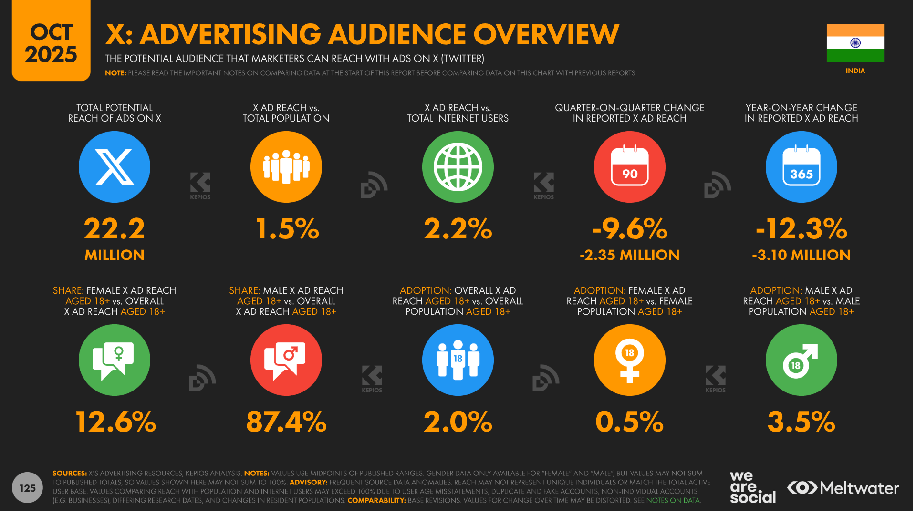
Okay, here’s where it gets uncomfortable—and where the opportunity is massive. Women make up 48.4% of India’s population (per UN population data), but only 35.6% of social media users. The skew gets worse on individual platforms—just 27.3% of Facebook’s adult users are women, 29.9% on Instagram, and a shocking 12.6% on X (according to Meta and X advertising data).
I’m going to be blunt: this isn’t just a demographic footnote. This represents hundreds of millions of potential customers that most digital strategies are completely ignoring.
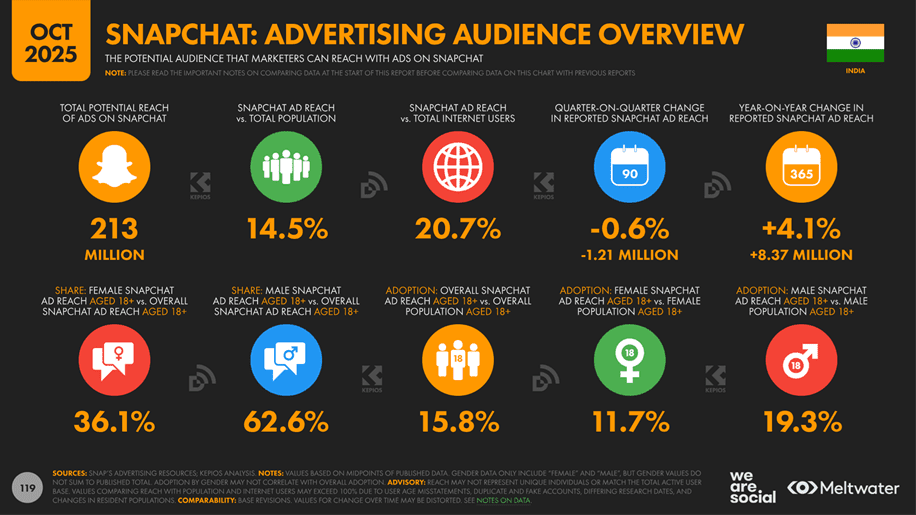
Look at what Nykaa did differently. Falguni Nayar didn’t just build an e-commerce platform for beauty products, she created a safe, supportive digital space specifically designed for women. Educational content about skincare. Non-judgmental beauty advice. Community features where women could share tips without trolls. The platform reached profitability way faster than male-dominated e-commerce players because they solved for trust and safety first, transactions second. Interestingly, Snapchat shows 36.1% female users among adults, better than most platforms. Why? My hypothesis: the ephemeral nature of content creates a psychologically safer environment. The AR filters are fun without being performative. The product design choices matter enormously when you’re trying to engage women in markets where digital spaces can feel hostile.
Urban vs. Rural: Two Different Internets
Despite rapid urbanization, 62.5% of Indians still live in rural areas versus 37.5% in urban centers (UN data). But here’s what every marketer needs to understand: rural doesn’t mean offline anymore.
I worked on a campaign for an agricultural inputs company last year. Our initial instinct was to focus on urban distributors. Then we dug into the data and realized that farmers themselves were increasingly going online, not through desktops in internet cafes, but through small range smartphones with vernacular interfaces.
We pivoted the entire strategy. Created WhatsApp-based advisory services in Marathi, Punjabi, and Telugu. Optimized for ultra-low bandwidth (think sub-1MB page weights). Built trust through local influencers, successful farmers in the region, not Bollywood celebrities. Revenue from rural markets grew 220% in eight months. The key insight: rural users aren’t a separate market, they’re just at a different stage of the digital adoption curve, with different constraints and different needs.
Platform Dynamics: Where the Attention Actually Is
Instagram’s Explosive Growth Story
Let me tell you what’s keeping Meta’s India team celebrating: Instagram hit 481 million users in India (32.8% of population), up 89.5 million year over year a 22.9% growth rate. Just in Q3 2025, they added 7.95 million users. At this pace, Instagram will surpass Facebook in absolute users within 12-18 months.
Why is Instagram winning? Three reasons, based on what I’m seeing in campaigns:
First, Reels. Short-form video is where young India lives. I ran a campaign for a fashion D2C brand where we spent ₹500,000 on Instagram ads – 70% went to Reels placements. The ROAS (Return on Ad Spend) on Reels was 4.8x versus 2.1x on feed posts. The algorithm favours video, users engage with video, and the shopping integration is seamless.
Second, creator economy. India now has one of the world’s largest creator bases, and Instagram is their primary monetization platform. Brands aren’t doing celebrity endorsements anymore, they’re partnering with micro and nano-influencers who have 5K-50K hyper-engaged followers. I’ve seen influencer campaigns deliver 8-12% engagement rates versus 0.5-1% for traditional brand content.
Third, shopping features. Instagram Shopping has turned the app into a full-funnel commerce engine. Discovery, consideration, purchase—all without leaving the app. For brands selling aspirational products to urban millennials and Gen Z, Instagram is non-negotiable.
YouTube: The Unshakeable Giant
YouTube remains India’s largest platform with 500 million users (34.1% of population), reaching 48.7% of all internet users. The growth has moderated to 1.8% year-over-year, but don’t mistake maturity for irrelevance.
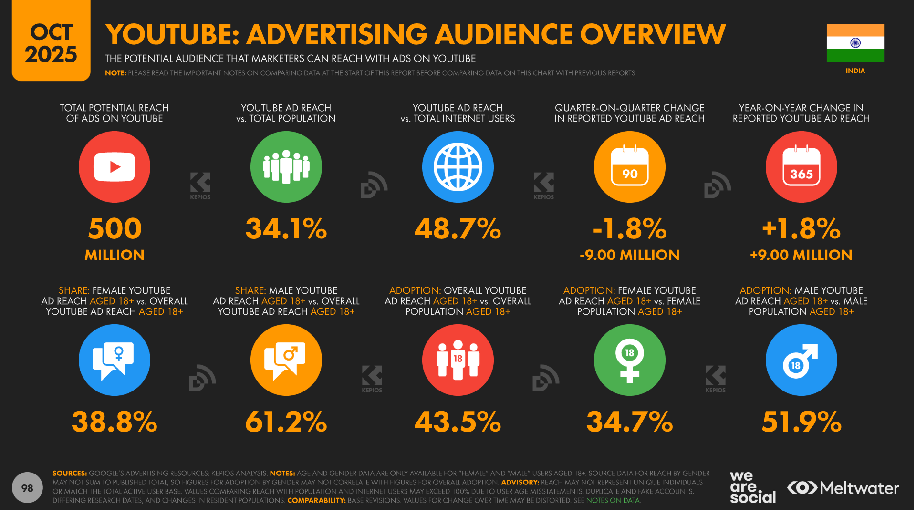
YouTube is where India learns. How to code. How to cook. How to fix a motorcycle. How to apply makeup. How to prepare for competitive exams. The platform has become the de facto university for hundreds of millions of Indians.
I ran a campaign for an edtech company where we tested YouTube pre-roll ads versus Facebook video ads. The YouTube campaign had a 3.2x higher completion rate and 40% lower cost-per-acquisition. Why? Context. People come to YouTube to learn. If your ad teaches something valuable, they’ll watch and they’ll click.
Plus, YouTube Shorts is now a serious competitor to Reels and TikTok clones. The monetization for creators is better, the reach is broader, and the integration with long-form content creates a sticky ecosystem that’s hard for newer platforms to replicate.
LinkedIn: The B2B Sleeper Hit
Here’s one that’s flying under the radar: LinkedIn hit 170 million members in India (11.6% of population), up 30 million year-over-year a 21.4% surge. Among adults 18+, that’s 16.4% penetration.
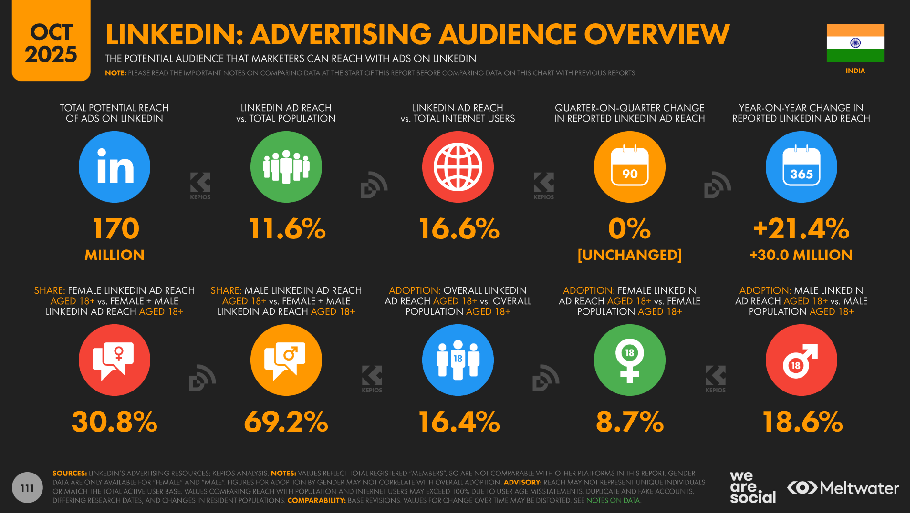
Why does this matter? India is producing millions of college graduates annually, and they’re all on LinkedIn building their professional brands. The platform has evolved from a job board into a full content and networking ecosystem.
For B2B marketers, LinkedIn is gold. I’ve run lead-gen campaigns for SaaS companies where LinkedIn delivered qualified leads at 60% the cost of Google Ads. The targeting is precise, you can pinpoint the VP of Marketing or any high-level decision-maker to showcase your product or service. Believe me, this level of pinpoint accuracy is unmatched by any other platform. Try doing that anywhere else, and you’ll end up burning your marketing budget.
The content game on LinkedIn India has also matured significantly. The days of cringey motivational quotes are fading (mostly). Real thought leadership, case studies, and industry insights are getting serious engagement. If you’re in B2B and you’re not on LinkedIn, you’re invisible.
Facebook: Still Massive, But…
Facebook has 403 million users in India (27.5% of population), growing 8.1% year-over-year with 30.3 million new users. It reaches 38.8% of adults 18+ and 39.3% of internet users. Those are huge numbers. But Facebook’s best days in India might be behind it, at least among urban millennials and Gen Z. The platform is increasingly a space for older users, community groups, and marketplace transactions.
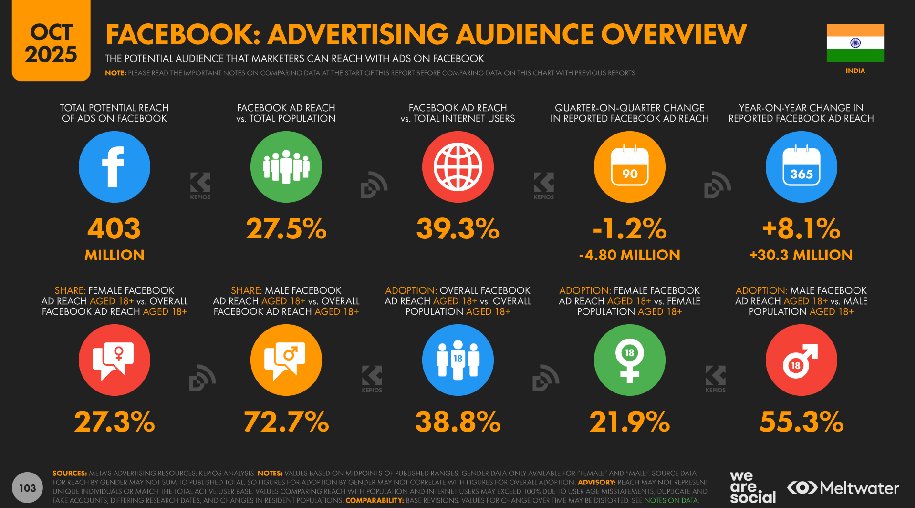
That said, don’t write Facebook off. For local businesses, community building, and reaching tier-2/tier-3 audiences, it’s still incredibly effective.
The Also-Rans and the Risers
Snapchat: 213 million users (14.5% of population), up 4.1% year-over-year. Still winning with younger demographics and AR features. Underrated platform for brands targeting teens and early twentysomethings.
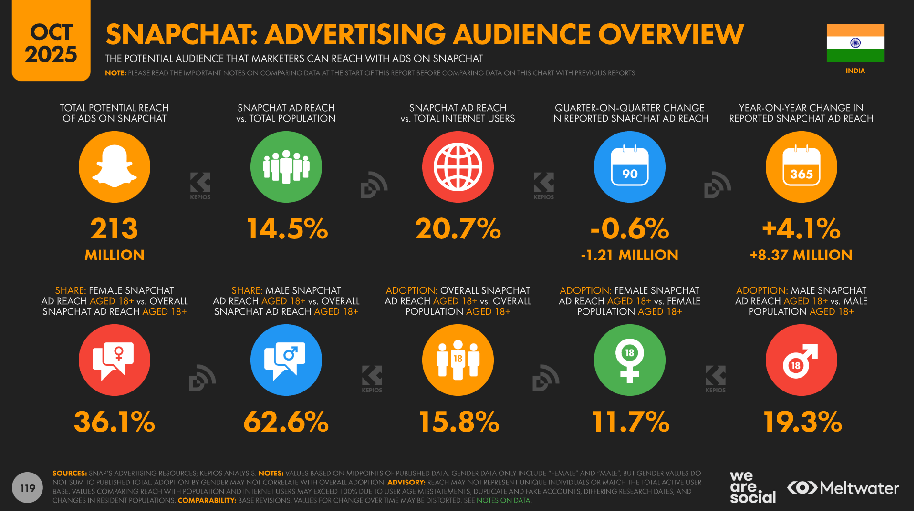
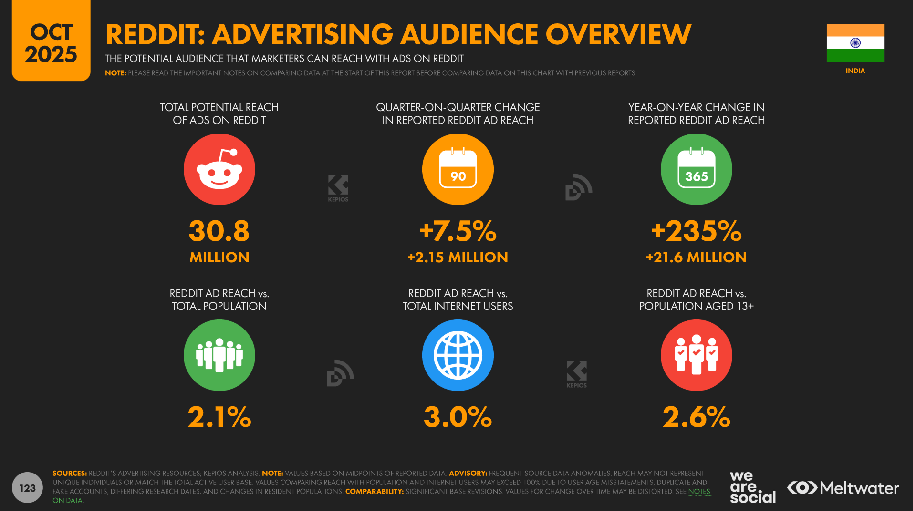
Reddit: 30.8 million users (2.1% of population), up 235% year-over-year. Explosive growth from a small base. Becoming the go-to for niche communities and authentic discussions. Smart brands are monitoring relevant subreddits for consumer insights.
X (Twitter): 22.2 million users (1.5% of population), down 12.3% year-over-year. Platform seems to be struggling in India. The negativity and algorithm chaos are driving users away.
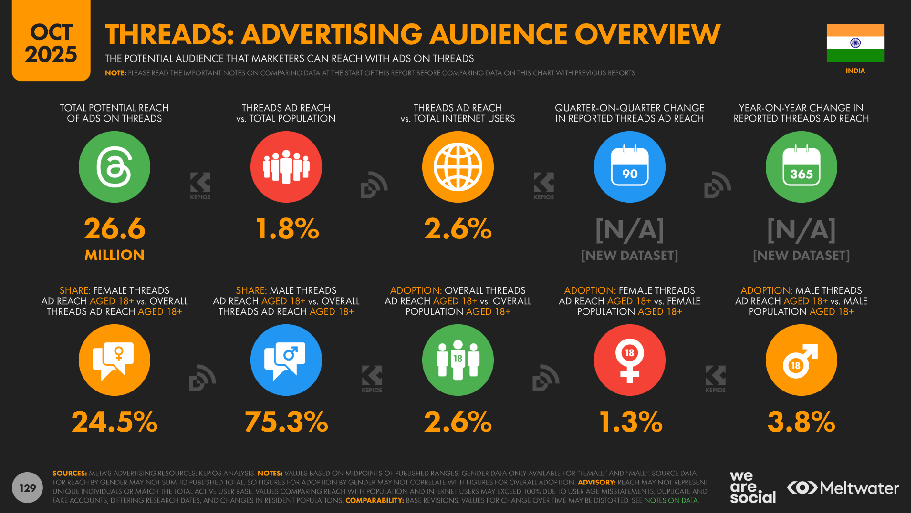
Threads: 26.6 million users (1.8% of population). Meta’s Twitter alternative is… fine? It hasn’t found its identity yet. Jury’s still out on whether it becomes essential or fades into irrelevance
Consumer Behavior: What’s Actually Working
Let me share what I’m seeing in real campaigns across 150+ SEO and digital marketing projects over the years:
Video Has Eaten Everything
If you’re still primarily creating text-based content, you’re fighting with one hand tied behind your back. Indians are consuming video at unprecedented rates YouTube, Reels, Shorts, Stories are true winner as the algorithm gods favor video across every platform.
But here’s the thing: it’s not just about making videos. It’s about understanding the vertical, snackable, value-first format. I ran A/B tests for a consumer electronics brand:
- 60-second vertical Reels showing product features: 8.2% engagement rate
- Same content as horizontal 2-minute YouTube video: 2.1% engagement rate
- Same content as carousel post with text: 0.7% engagement rate
The format isn’t just packaging, it’s the entire message. Vertical video feels native to the mobile experience. Snackable length respects attention spans. Value-first hooks (“Here’s how to…”) stop the scroll.
Vernacular Is Non-Negotiable
English-only digital strategies are leaving 70% of potential customers on the table. The next 440 million internet users will be predominantly vernacular, and even current users increasingly prefer content in their native languages.
I worked with an insurance company that translated their landing pages into Hindi, Tamil, and Bengali. Not just the text, we localized the imagery (showing people in regional clothing), the testimonials (using common local names), and even the form field labels. Conversion rates in tier-2 cities jumped 67%.
But translation alone isn’t enough. Cultural localization is what separates winners from losers. Zomato gets this brilliantly, their regional campaigns for festivals like Durga Puja in Bengal or Onam in Kerala aren’t just translated; they’re culturally reimagined from scratch.
Social Commerce Is the Future
The lines between social media and e-commerce are disappearing. Instagram Shopping, WhatsApp Business, and emerging platforms are creating frictionless purchase paths that skip traditional e-commerce sites entirely.
A fashion brand I consulted for built their entire business model around Instagram. No standalone website. Product discovery happens through influencer posts and Reels. Transactions happen via Instagram Shopping. Customer service via DMs. Their customer acquisition cost was 40% lower than competitors running traditional e-commerce.
The real magic happens when you layer in community. WhatsApp groups where customers share styling tips. Instagram Stories showing real customers (not models) wearing the products. User-generated content that builds social proof organically. The transaction is almost incidental, it’s the natural conclusion of a relationship built through content and community.
Trust Beats Transactions
Indian consumers are skeptical of digital transactions and for good reason. Scams are rampant. Privacy violations are common. Many first-time internet users are navigating a landscape where they don’t know who to trust.
The brands winning right now are the ones investing in trust-building before asking for the sale. PhonePe and Google Pay didn’t just build payment apps, they built educational campaigns showing exactly how UPI works, addressing security concerns, and creating social proof through referral programs.
In my work, I’ve found that case studies, testimonials, and transparent pricing beat aggressive discounting every time when it comes to building long-term customer relationships. The customer lifetime value of trust-first marketing is 3-4x higher than transaction-first marketing.
Where the Smart Money Is Going
Based on everything I’m seeing the data, the trends, the campaign results here’s where I’d be placing my bets:
1. Instagram Reels + Shopping for D2C Brands
With Instagram growing 22.9% year-over-year and reaching 481 million users, the platform is at an inflection point. But the real opportunity isn’t just being on Instagram, it’s mastering the full funnel within the platform.
Build a content engine that pumps out Reels consistently (think 4-5 per week minimum). Partner with micro-influencers in your niche. Use Shopping tags on every product mention. Drive traffic to Stories for limited-time offers. Retarget engaged users with conversion-focused ads.
The brands crushing it on Instagram aren’t treating it like a billboard, they’re treating it like a complete commerce ecosystem. Discovery, education, social proof, transaction, and retention all in one place.
2. Women-Centric Digital Strategies
With women representing just 35.6% of social media users despite being 48.4% of the population, there’s a massive gender gap to close and massive opportunity for brands that do it right.
This isn’t about pink-washing your marketing. It’s about fundamentally rethinking safety, privacy, and value propositions for women users. Create moderated community spaces. Offer privacy controls that actually matter. Feature real women, not models, in your content. Address real concerns time poverty, household decision-making dynamics, balancing multiple roles.
3. B2B LinkedIn Thought Leadership
With LinkedIn growing 21.4% to 170 million users, the B2B opportunity is exploding. But most B2B brands are still treating LinkedIn like a press release distribution channel.
The opportunity: authentic thought leadership. Share actual insights from your work. Post case studies with real numbers. Write about industry challenges without always pitching your solution. Engage genuinely in comments and discussions.
I’ve seen CMOs build personal brands on LinkedIn that generate more qualified leads than their company’s entire paid marketing budget. The secret? Consistently showing up, sharing valuable content, and being a real human instead of a corporate mouthpiece.
4. Hyper-Local Vernacular Content at Scale
The future isn’t one Hindi translation of your English content. It’s dozens of regionally-specific, culturally-nuanced campaigns running simultaneously.
Swiggy and Zomato are masters at this. Different campaigns for different cities, timed to local festivals, using local slang, featuring local restaurants. It’s operationally complex, but the engagement rates are 3-5x higher than generic national campaigns.
The technology now exists to do this at scale, AI translation that preserves cultural context, local creator networks, programmatic regional targeting. The brands that invest in the infrastructure to execute hyper-local strategies will dominate their categories.
The Challenges Nobody Talks About (But Everyone Faces)
Look, I’m bullish on India’s digital future, but let’s be real about the challenges:
Digital Literacy Is Still a Huge Barrier
Millions of new internet users literally don’t understand how the internet works. They don’t know the difference between a Google search and a website URL. They can’t tell legitimate apps from scams. They struggle with basic form fills.
I watched user testing sessions where people spent 5 minutes trying to figure out a “Submit” button because the iconography wasn’t intuitive. This isn’t a UX problem—it’s a digital literacy problem. And it means your “simple” checkout flow might be incomprehensible to 30% of your potential customers.
The solution? Ruthless simplification. Visual interfaces over text-heavy ones. Voice inputs as defaults. Tutorial videos at every step. Customer support that’s actually helpful instead of a chatbot that frustrates users into giving up.
Infrastructure Remains Inconsistent
Yes, median mobile speeds hit 131.77 Mbps but that’s median. Millions of users are still on spotty 3G connections. Power cuts interrupt sessions. Data caps force conservative browsing behavior.
Platform Dependency Is Risky
Building your entire business on Instagram or YouTube is tempting until the algorithm changes and your reach drops 60% overnight. I’ve seen it happen. Multiple times.
The smart play: use platforms for discovery and growth, but own your customer relationships. Build email lists. Create WhatsApp broadcast lists. Drive traffic to owned properties. Diversify across channels. Platform algorithms are fickle customer relationships are durable.
Privacy and Regulation Are Evolving
India’s data protection landscape is changing fast. Consumers are becoming more aware of privacy issues. Regulators are paying attention. The playbook that worked in 2020 aggressive data collection, loose consent mechanisms, opaque targeting won’t fly much longer.
Get ahead of this. Build privacy-first strategies now. Be transparent about data usage. Give users real control. The brands that build trust through responsible data practices will have a massive advantage when regulations tighten further.
What I’m Telling My Clients About 2026 and Beyond
After 14 years in this industry, working across 150+ campaigns, I’ve learned that the data tells you what is happening but you need experience and intuition to understand why it’s happening and what to do about it.
Here’s what I know: India’s digital transformation is real, it’s accelerating, and it’s creating once-in-a-generation opportunities. But only for brands willing to do the hard work of truly understanding this market.
The Non-Negotiables
- Mobile-only mindset: Stop designing for desktop and adapting for mobile. Design for mobile period. Better yet, design for a ₹10,000 Android phone on a 4G connection in tier-3 city. That’s your baseline.
- Video-first content: If you’re not creating Reels, Shorts, and Stories, you’re invisible to the algorithm and invisible to users. Vertical video is the language of mobile India.
- Vernacular and local: English-only strategies are just half run for mass market brands. Invest in real localization – language, culture, context. Don’t just translate; reimagine.
- Platform diversification: Build on platforms, but own your customer relationships. Email, WhatsApp, owned properties create redundancy so algorithm changes don’t kill your business.
- Trust before transactions: Invest in building trust through transparency, education, social proof, and genuine customer care. The long-term value is exponentially higher.
Looking Toward 2027
If current trends hold and I believe they will we’ll see internet penetration push past 75%, possibly hitting 80% by late 2027. Instagram will surpass Facebook in absolute users. Rural internet adoption will continue accelerating.
AI will become more embedded in consumer experiences vernacular AI assistants, automated content localization, predictive shopping, voice-first interfaces. 5G coverage will expand significantly, enabling richer, more immersive experiences.
Social commerce will mature from experimental to essential. Platforms will consolidate further the winners will get stronger, and marginal players will fade. And we’ll likely see new regulation around data privacy, platform accountability, and digital payments.
A Final Thought
India isn’t just another market. It’s a fundamentally different digital ecosystem shaped by unique constraints, behaviors, and opportunities. The playbooks from Silicon Valley or even other Asian markets won’t work here without serious adaptation.
But for marketers willing to do the work to really understand the nuances, invest in localization, build for mobile-first users, create trust-first relationships and then rewards are extraordinary.
The data in the Digital 2026 India report gives you the map. But you still need to walk the terrain, talk to real users, test relentlessly, fail fast, and keep learning.
India’s digital future is being written right now. Make sure you’re part of the story. Don’t forget – we still have 440 million additional internet users to come.
Data Sources & Citations: