ACP vs UCP: The Two Protocols Powering $300B+ Agentic Commerce by 2030
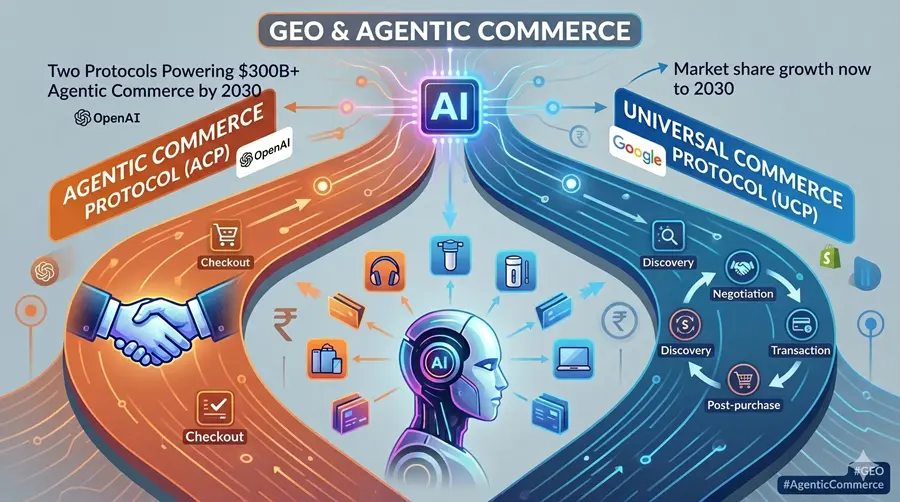
Two open protocols are quietly redefining how money moves on the AI-powered web and if you run an e-commerce site, you’re already behind if you haven’t heard of them.
Think about the last time you bought something online. You searched, clicked through a few pages, compared prices, filled in your shipping details, fumbled for your credit card, and finally hit confirm. The whole process from start to finish probably took 20 to 40 minutes. Now imagine that entire journey compressed to a single sentence: “Order me a replacement water filter that fits my Brita, under ₹1,500, delivered by Friday.” An AI agent handles the rest. That is agentic commerce.
For this to work at internet scale, across thousands of merchants, dozens of AI platforms, and billions of transactions agents and merchants need a common language. Something like HTTP for the web, but built for autonomous buying. That language now exists in two forms: the Agentic Commerce Protocol (ACP), developed by OpenAI and Stripe, and the Universal Commerce Protocol (UCP), built by Google and Shopify alongside a coalition of 20+ global partners.
These aren’t theoretical white papers. ACP shipped in production in September 2025 with ChatGPT’s Instant Checkout. UCP went live in Google AI Mode in February 2026. The rails are already being laid underneath you. Whether your store is on them is the question this post answers.
What Is Agentic Commerce?
Agentic commerce is the end-to-end execution of commercial transactions by autonomous AI agents without meaningful human intervention at each step. These agents research, compare, negotiate, and complete purchases on behalf of users, guided by a set of natural-language instructions and constraints. They are not chatbots suggesting products, and they are not recommendation engines surfacing ads. They take action: they add items to carts, apply coupons, enter payment credentials, and confirm orders.
The difference from traditional e-commerce is structural. For a deep-dive into the broader shift in how AI systems interact with digital infrastructure, see Cloudflare Markdown for Agents and the GEO Stack on this blog, yet the short version is this: the web is being re-read by machines, not humans, and commerce is the highest-stakes arena where that shift plays out.
How an Agentic Transaction Actually Works
A complete agentic commerce flow breaks down into six stages:
- Goal Capture –The user provides a natural-language request with constraints: budget, brand preference, delivery deadline, or any other parameter.
- Reasoning & Planning –The agent parses intent, builds a search and comparison strategy, and determines which APIs and product sources to query.
- Real-Time Sourcing –The agent queries multiple merchant inventory APIs simultaneously, gathering pricing, availability, ratings, and shipping estimates in parallel.
- Decision & Approval – The agent presents its top choices with a plain-language rationale. The user reviews and confirms or adjusts the criteria.
- Autonomous Transaction – The agent executes checkout via tokenised, securely stored payment credentials. No form-filling, no password entry.
Post-Purchase Management – The agent monitors delivery, handles exceptions, initiates returns if necessary, and can flag anomalies proactively.
| Dimension | Traditional E-Commerce | Agentic Commerce |
| Buyer | Human browsing manually | AI agent acting autonomously |
| Discovery | Search engine → click → navigate | Agent queries APIs in parallel |
| Decision Making | Human reads reviews & compares | AI reasons across dozens of signals |
| Checkout | Manual form-fill, login, payment | Tokenised, one-step, zero-friction |
The shift from “search → click → buy” to “ask AI → agent buys” is the single most significant structural change in digital commerce since the introduction of the shopping cart.
Why Agentic Commerce Actually Matters For Shoppers and Sellers Alike
There is a statistic worth sitting with for a moment: approximately 23% of Americans had already made a purchase using AI in the 30 days before December 2025, according to Morgan Stanley research. That is not a pilot. That is early-mainstream adoption, and it happened before either ACP or UCP had reached their current production capabilities.
What Buyers Get
- Speed: Research and purchase tasks that take 30–60 minutes are compressed to under a minute. The agent does the comparison shopping you were always meant to do but rarely had time for.
- Better Decisions: No human can simultaneously compare products across dozens of retailers with perfect recall of pricing history and review sentiment. An AI agent can, and does.
- Zero-Friction Checkout: No forms, no forgotten passwords, no cart abandonment mid-way through a clunky mobile checkout flow. Cart abandonment which averages 70%+ across global e-commerce drops sharply when an agent completes the purchase.
- Proactive Management: Returns initiated without a phone call. Subscription renewals adjusted automatically. The agent becomes the buyer’s personal commerce concierge.
What Businesses Get
- Higher Conversion, Lower CAC: AI agents arrive with a qualified, high-intent purchase request. There is no aimless browsing, no window-shopping. The cost per acquisition on agent-driven traffic is structurally lower.
- Richer Intent Data: Agent queries are explicit: “Noise-cancelling headphones, under $200, ships to Mumbai, Sony or Bose preferred.” That is a structured brief, not a cookie-based probabilistic guess. For marketers, this is a step-change in signal quality.
- New Revenue Channel: Merchants who expose ACP/UCP endpoints capture agentic traffic that agent-unfriendly competitors miss entirely. First-mover advantage here mirrors the early days of structured data and Google Shopping.
- Reduced Operational Load: When post-purchase is handled by agent-to-API communication, customer service volumes for routine queries drop. Returns, delivery queries, and reorders become automated touchpoints.
“AI agents influenced $3 billion in US Black Friday 2025 sales.” – Salesforce Commerce Cloud Report, November 2025
| Key Takeaways |
| • ~23% of Americans made AI-assisted purchases in a single month before current-gen protocols reached maturity. |
| • Agentic traffic is high-intent, low-friction, and growing faster than traditional search-driven traffic. |
| • For merchants, the window to get ahead of competitors is narrow 12–18 months at most. |
The Infrastructure Gap: Why Protocols Had to Exist
Before ACP and UCP, every major AI platform was solving the same problem in isolation. ChatGPT was building proprietary checkout integrations. Google was negotiating individual merchant deals for AI-assisted shopping. Perplexity was experimenting with its own “buy now” mechanics. The result was a fragmented, unscalable patchwork that made adoption expensive for merchants and unreliable for users.
The parallel to the early web is exact. In the 1990s, every network was building its own communication standard. HTTP changed that by giving every web client and server a shared language. ACP and UCP are doing the same for AI commerce: giving agents and merchants a standardised interface so that any compliant agent can transact with any compliant merchant, without bespoke integrations.
Both protocols are open-source under Apache 2.0 licensing, meaning any merchant, developer, or platform can implement them without royalties or vendor lock-in. That is deliberate the founding teams learned from the SSL/TLS story that security and trust infrastructure in commerce only works if adoption is universal, not gated.
ChatGPT’s Instant Checkout, launched in September 2025, was the first major proof point that protocol-driven agentic commerce works in real production environments not sandboxed demos. You can read the technical spec at the ACP official site and the ACP GitHub repository.
‘ACP’ The Agentic Commerce Protocol
“ACP is the ‘checkout counter’ protocol and laser-focused on the transaction moment.”
The Agentic Commerce Protocol is an open standard developed jointly by OpenAI and Stripe to standardise the checkout transaction between an AI agent and a merchant. If you use ChatGPT or Microsoft Copilot to buy something, you are interacting with ACP’s infrastructure.
ACP’s design philosophy is deliberately narrow: it does one thing, and it does it well. Rather than attempting to cover the entire commerce lifecycle, ACP focuses on the moment of transaction the exchange of product data, pricing, and payment between agent and merchant. This makes it faster to implement and easier to reason about for both merchants and developers.
How an ACP Transaction Flows
- The user expresses purchase intent in a natural-language conversation within ChatGPT or a Copilot-powered interface.
- The agent sends a structured checkout request to the merchant’s ACP endpoint, specifying product, quantity, constraints, and delivery requirements.
- The merchant’s ACP server returns product details, real-time pricing, and availability.
- The agent presents the top options with a plain-language summary. The user approves.
- Payment is processed via Stripe (or another ACP-compatible payment service provider) using secure, tokenised payment credentials no card details transmitted in plain text.
- An order confirmation is returned to both the agent and the buyer, with tracking information passed back when available.
Critically, ACP uses a .well-known/acp endpoint for merchant discovery a machine-readable manifest that tells any compliant AI agent what the merchant supports, what products are available, and how to initiate a transaction. Think of it as a robots.txt for purchasing agents. It is REST-compatible and supports the Model Context Protocol (MCP), making it natively interoperable with the growing ecosystem of MCP-enabled tools and platforms.
ACP Adoption Timeline
| Date | Milestone |
| Sept 2025 | ACP public launch Etsy sellers go live with ChatGPT Instant Checkout |
| Oct 2025 | Salesforce integrates ACP into its Commerce Cloud ecosystem |
| Jan 2026 | v2026-01-16: Capability negotiation layer added |
| Apr 2026 | v2026-04-17: Cart, product feed, orders, and native MCP transport support |
The April 2026 release is particularly significant: native MCP support means ACP is now interoperable with the broader Model Context Protocol ecosystem, opening up agentic commerce to any MCP-compatible AI client well beyond ChatGPT.
‘UCP’ The Universal Commerce Protocol
“UCP is the ‘full shopping mall’ protocol from browsing aisles to processing returns.”
Where ACP handles the transaction moment, the Universal Commerce Protocol covers the entire commerce lifecycle from the first moment of product discovery through to post-purchase support. Developed by Google and Shopify in partnership with Etsy, Wayfair, Target, and Walmart (among others), UCP is the more ambitious of the two standards in both scope and coalition.
The UCP coalition now includes more than 20+ major partners spanning payments infrastructure (Visa, Mastercard, American Express, Stripe, PayPal, Klarna, Adyen, Affirm), major US retailers (Target, Walmart, Sephora, Macy’s, Home Depot, Best Buy, Kroger, Ulta Beauty, Zalando), and platform providers including Salesforce. This is not a niche experiment it is the most broadly adopted commercial protocol standard since OAuth.
How UCP Is Structured
UCP operates as a layered protocol stack, with each layer handling a distinct phase of the commerce journey:
- Discovery Layer: Enables AI agents to find, understand, and filter products across merchant catalogs using structured capability declarations.
- Negotiation Layer: Handles price, availability, shipping options, and terms between agent and merchant in real time.
- Transaction Layer: Manages secure checkout, payment processing, and order confirmation comparable in scope to ACP’s core function.
- Post-Purchase Layer: Covers order tracking, return initiation, refunds, and reorder automation. This is the layer ACP currently does not address.
Merchants implement UCP by declaring their capabilities at a /.well-known/ucp endpoint. The architecture is server-selectable: merchants control which version of the protocol they expose and which capabilities they enable, allowing for phased rollouts rather than all-or-nothing adoption. Transport support is broad REST, JSON-RPC, MCP, and Agent-to-Agent (A2A) protocols are all supported, giving the protocol flexibility across different AI platform architectures.
Key UCP Milestones
- February 2026: Live checkout in Google AI Mode for US shoppers Etsy and Wayfair were the launch merchants.
- April 2026 (v2026-04-08): Formal cart support, product feed capabilities, signing infrastructure, and trust framework additions. Full technical spec available at the UCP GitHub.
- Ongoing: Google Merchant Center is actively publishing UCP integration guidance for merchants already in the Google Shopping ecosystem.
ACP vs UCP : A Direct Comparison
| Feature | ACP (OpenAI + Stripe) | UCP (Google + Shopify) |
| Lead Developers | OpenAI + Stripe | Google + Shopify (+ 20 partners) |
| Primary Focus | Checkout transaction | Full commerce lifecycle |
| Scope | Transaction layer only | Discovery → checkout → post-purchase |
| Transport | REST, MCP | REST, JSON-RPC, MCP, A2A |
| AI Platforms | ChatGPT, Microsoft Copilot | Google AI Mode, Gemini, others |
| Payment Partners | Stripe (primary) | Visa, Mastercard, Stripe, PayPal, Klarna, Affirm, Adyen |
| Retail Partners | Etsy (launch), Salesforce ecosystem | Walmart, Target, Sephora, Macy’s, Best Buy, Kroger, Ulta, Zalando |
| Discovery Support | ACP Manifest at .well-known | /.well-known/ucp with full capability declaration |
| Post-Purchase | Limited (order confirmation) | Full returns, tracking, reorders |
| Current Status | Beta (v2026-04-17) | Active (v2026-04-08) |
| License | Apache 2.0 | Apache 2.0 |
| Best For | ChatGPT-driven checkout optimisation | Full agent commerce journey & multi-platform discoverability |
Three Things the Table Doesn’t Tell You
1. They are complementary, not competing. The most common misconception is that merchants have to choose. They don’t. ACP handles the transaction moment for ChatGPT and Copilot users. UCP handles the full lifecycle across Google AI Mode, Gemini, and the broader coalition. A dual-protocol implementation gives you maximum coverage across all major AI surfaces. Stripe, which is the payment infrastructure behind ACP, also endorses UCP that alignment is telling.
2. The discovery model is what makes agents work. Both protocols rely on .well-known endpoint declarations for agent discovery. If your store does not publish these manifests, you are invisible to compliant agents. It is the functional equivalent of not having a sitemap you exist, but you won’t be found.
3. Dual-protocol strategy is already being adopted by the largest merchants. Retailers like Etsy, which was an early adopter on both ACP and UCP, demonstrate that the implementation cost of running both is low relative to the coverage gained. If Etsy sellers can do it, any Shopify or WooCommerce merchant can.
What This Means for SEO, GEO, and Your E-Commerce Strategy
Generative Engine Optimization is the practice of making your content and commerce infrastructure legible to AI systems, not just human users and traditional search crawlers. ACP and UCP are not separate from GEO they are its transactional layer. You can have perfectly optimised product content that an AI can understand, but if that AI cannot transact from your store, the opportunity is lost at the finish line.
The SEO parallel is exact, and the lesson of history is instructive. Merchants who adopted structured data markup in 2011 and 2012, when Google’s rich snippets were still experimental captured years of enhanced visibility before it became table stakes. The merchants who waited until structured data was universal found only parity, not advantage. ACP and UCP are in that 2011–2012 window right now.
The New Optimization Stack
- Generative Engine Optimization (GEO): Making your content legible and authoritative to AI systems structured product descriptions, semantic HTML, schema markup.
- Model Context Protocol (MCP): Giving AI agents the tools to interact with your inventory, CMS, and product data in structured, real-time ways.
- ACP + UCP: Making your store transactable by agents. GEO without transactability is a half-completed strategy.
The .well-known endpoints are the new robots.txt. Just as every serious web presence publishes a robots.txt to communicate with crawlers, every serious e-commerce presence will need to publish ACP and UCP manifests to communicate with purchasing agents.
Your 5-Step Action Plan for 2026
- Audit Your Infrastructure – Is your platform API-first? Shopify, WooCommerce (with WooCommerce REST API), and headless commerce platforms are already architecturally compatible. Magento and BigCommerce can be configured. Legacy monolithic platforms may need investment.
- Implement Structured Product Data – Schema.org Product, Offer, and Review markup on every product page. This is the foundation that both ACP discovery and UCP capability declarations build on. Without clean structured data, protocol adoption will underperform.
- Expose ACP and UCP Endpoints – Publish manifests at /.well-known/acp and /.well-known/ucp. Start with checkout capabilities, then expand to cart, orders, and post-purchase as your team capacity allows. Both protocols support phased rollout.
- Enable AI-Friendly Content Delivery – Semantic HTML, clean product descriptions that read clearly without visual context, Content Signals headers, and Markdown delivery for agent consumers. See the Cloudflare Markdown for Agents post on this blog for the implementation specifics.
- Monitor Agentic Traffic – Track GPTBot, Google-Extended, Claude-Web, PerplexityBot, and agent-specific user-agents in your server logs. Set KPIs for agentic checkout volume and agent-driven revenue share. Without measurement, you cannot optimise.
The $300B+ Opportunity: What the Forecasts Actually Say
Market forecasts for agentic commerce are not modest. And unlike many AI market projections that float in the ether of “by 2035” or “by 2040,” these are anchored in near-term adoption data, observable behaviour changes, and the specific infrastructure milestones that ACP and UCP represent.
The Numbers
- Morgan Stanley (December 2025): $190 billion–$385 billion in US e-commerce by 2030, representing 10%–20% of total market share.
- Bain & Company: $300 billion–$500 billion by 2030, equivalent to 15%–25% of total US e-commerce. Bain also reports that 30%–45% of US consumers are already using generative AI for product research.
- Salesforce Black Friday 2025: AI agents influenced $3 billion in US sales over a single four-day period. That is not a projection it is a measurement of transactions that already occurred.
The India Angle
For Indian merchants and D2C brands, this transition carries particular strategic weight. India’s digital commerce infrastructure UPI payment rails, the ONDC open network, a massive base of mobile-first consumers is structurally well-matched to agent-driven commerce models. See the post on India’s Digital Landscape 2026 on this blog for the full picture.
Indian merchants on Shopify, WooCommerce, and Magento are already inside the ACP and UCP ecosystem by virtue of their platforms. The incremental step to full protocol compliance is smaller than it appears. And the upside is global, not just domestic: a compliant Indian D2C brand is as discoverable to a US-based AI shopping agent as any American competitor with an equivalent catalog.
The D2C brands that invest in protocol compliance in 2026 are not just preparing for Indian agentic commerce. They are positioning for international AI agent traffic that no traditional digital marketing channel can replicate.
The Bottom Line
The agentic web is not coming. It is already transacting. ACP and UCP are the rails on which it runs one built for the checkout moment, the other for the full commerce journey. Between them, they cover every major AI platform currently in consumer hands, and they have the backing of every major financial institution and retail chain that matters.
The merchants who implement in 2026 gain a 12-18 month head start before dual-protocol compliance becomes an expectation rather than a differentiator. The window is not permanently open. The structured data parallel is instructive: the merchants who waited until rich snippets were universal found only parity with competitors who moved early.