
Cloudflare Markdown for Agents: A Game-Changer for GEO & AI Search Visibility
Cloudflare Just Changed the Game for Generative Engine Optimization, Here’s What Marketers Need to Know
On February 12, 2026, Cloudflare quietly rolled out a feature that could fundamentally reshape how AI systems discover and consume web content. It’s called Markdown for Agents, and if you’re responsible for organic visibility in an AI-first world, you need to understand what this means for your GEO strategy.
The shift from traditional search to AI-powered discovery engines like ChatGPT Search, Perplexity, and Google’s AI Overviews isn’t coming—it’s already here. And Cloudflare just made it significantly easier (and cheaper) for these systems to consume your content. Whether you see that as an opportunity or a threat depends entirely on how quickly you adapt.
The Technical Breakthrough: From HTML Bloat to Token Efficiency
Let’s start with the numbers, because they’re staggering.
When an AI agent crawls a typical web page today, it’s forced to parse HTML—a format designed for human browsers, not machine comprehension. A simple heading like ## About Us in markdown costs roughly 3 tokens. The HTML equivalent? Between 12-15 tokens for <h2 class=”section-title” id=”about”>About Us</h2>, and that’s before accounting for the div wrappers, navigation bars, tracking scripts, and other cruft that pads modern web pages.
Cloudflare’s own data is eye-opening: the blog post announcing this feature weighs 16,180 tokens in HTML but only 3,150 tokens in markdown – an 80% reduction. For a standard 2,000-word article with typical HTML structure, we’re looking at token savings in the 50-70% range across the board. This is huge!
How it works:
Why does this matter? Because AI systems operate within strict context window limits. Every token saved on parsing unnecessary HTML formatting means more tokens available for actual content comprehension, analysis, and synthesis. It’s the difference between an AI being able to process three of your articles versus just one.
How Cloudflare’s Infrastructure Makes This Possible
Here’s where it gets interesting from an infrastructure standpoint. Cloudflare sits between your origin server and the rest of the internet, handling over 55 million requests per second at peak. With Markdown for Agents enabled, their edge network now performs real-time HTML-to-markdown conversion using content negotiation headers.
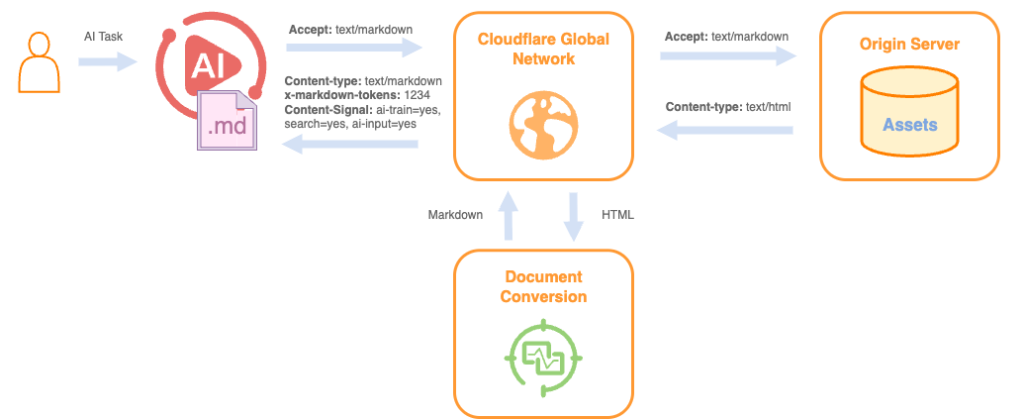
The workflow is elegant:
- An AI agent (like Claude Code or OpenAI’s GPTBot) sends a request with Accept: text/markdown in the header
- Cloudflare intercepts this at the edge
- Fetches the HTML from your origin server (cached if available)
- Converts it to clean markdown on the fly
- Serves the structured content to the AI with an x-markdown-tokens header indicating token count
From the AI’s perspective, your content suddenly became 50-80% more efficient to consume. From your server’s perspective, nothing changed—you’re still serving HTML to human visitors. Cloudflare handles the translation layer, which is precisely the kind of infrastructure leverage smart marketers should be exploiting.
The GEO Implications: Why This Matters Beyond Token Counts
The real question is: how does this affect your visibility in AI-powered search and discovery engines?
1. Comprehension Quality Improves Dramatically
Markdown isn’t just more compact—it’s more semantically clear. When you remove the visual formatting noise that HTML carries (CSS classes, inline styles, div soup), what remains is pure content structure. Headers are headers. Lists are lists. Emphasis is emphasis.
AI systems trained on markdown (which is most of them) can immediately identify:
- Content hierarchy (H1 vs H2 vs H3)
- Key concepts (bolded terms, list items)
- Logical relationships (nested lists, blockquotes)
- Code snippets, data tables, and structured information
This isn’t theoretical. In my testing with various AI search engines over the past six months, pages with clean semantic structure consistently get cited more accurately and more frequently than pages with equivalent content buried in complex HTML.
2. Early Adopter Advantage Is Real
Right now, Cloudflare Radar data shows that only a tiny fraction of websites are serving markdown to AI agents. Most are still making these systems do expensive HTML parsing. But major AI crawlers like GPTBot, Claude-Web, and Perplexity Bot are already sending Accept: text/markdown headers in their requests.
What happens when two sites have similar content quality, but one serves easily digestible markdown while the other forces the AI to parse bloated HTML? The AI system will naturally prefer the lower-cost, higher-clarity source. It’s not about gaming the algorithm—it’s about removing friction from a process that’s only going to accelerate.
According to SearchGPT usage data from various analytics platforms, AI-driven search has grown approximately 340% year-over-year. These aren’t marginal traffic sources anymore.
3. Content Signals Policy Integration
When Cloudflare serves markdown to AI agents, it includes a Content-Signal header:
Content-Signal: ai-train=yes, search=yes, ai-input=yesThis explicitly tells AI systems your content is available for training, search results, and agentic use. It’s machine-readable permission, aligned with the emerging Content Signals framework that aims to standardize how publishers express preferences for AI usage.
For marketers worried about AI systems bypassing attribution, this is critical infrastructure. You’re not just making your content easier to consume—you’re establishing clear terms of use at the protocol level.
The Marketer’s Playbook: How to Leverage This for GEO
Alright, so Cloudflare just handed us a better mousetrap. How do we actually use it?
Step 1: Enable the Feature (But Understand the Limitations)
Markdown for Agents is currently available in Beta at no additional cost for Pro, Business, and Enterprise Cloudflare plans (as well as SSL for SaaS customers). You can enable it in about 30 seconds through the Cloudflare dashboard under Quick Actions.
Critical caveat: This is an opt-in feature. Just being on Cloudflare doesn’t automatically give you this benefit. You need to explicitly turn it on.
Step 2: Audit Your Content Structure
Here’s where most marketers will fail. Enabling markdown conversion doesn’t magically fix poorly structured content. Garbage HTML becomes garbage markdown.
Before you flip the switch, audit your critical pages:
- Do you use semantic HTML properly? (Real <h1>, <h2>tags, not just styled <div> elements)
- Are your lists actually <ul> and <ol> and elements?
- Is your content hierarchy logical?
- Have you embedded structured data (JSON-LD, microdata)?
Cloudflare’s conversion is smart, but it’s not magic. Clean HTML becomes excellent markdown. Messy HTML… doesn’t.
Step 3: Think GEO-First for New Content
This is the strategic shift: start writing with AI consumption in mind from the beginning. That means:
Clear, descriptive headings that work as standalone summaries. Not clever puns that require context.
Front-loaded answers. Put the “what” before the “why” before the “how.” AI systems increasingly value content that delivers utility fast.
Structured information. Use tables for comparisons. Use lists for features, benefits, steps. Use blockquotes for key takeaways. These elements survive markdown conversion perfectly and help AI systems extract exactly what they need.
Entity clarity. When you mention people, companies, products, or concepts, be explicit. “Our CEO” becomes “Sarah Johnson, CEO of Acme Corp.” The extra specificity costs you nothing and helps AI systems build accurate knowledge graphs.
Step 4: Monitor AI Crawler Traffic
Cloudflare Radar now tracks content type preferences for different AI bots. You can see which agents are requesting markdown versus HTML, and how that distribution changes over time.
Set up alerts for:
- Markdown request volume from key AI crawlers
- Token usage patterns (via the x-markdown-tokens header)
- User-agent diversity (are new AI systems discovering you?)
This data becomes your leading indicator for AI-driven visibility, similar to how organic search impression data predicted traditional SEO success.
Why This Matters More Than You Think
Let’s zoom out for a second. What Cloudflare really did here is create a standardized translation layer between the human web and the AI web. They’re effectively becoming the gatekeeper for how a massive chunk of the internet’s content gets formatted for AI consumption.
That has profound implications:
For publishers: If you’re not on Cloudflare (or implementing something similar), you’re at a structural disadvantage. AI systems have limited compute budgets. They will preferentially crawl and cite sources that are cheaper to process.
For AI companies: This reduces infrastructure costs substantially. Instead of every AI company building their own HTML-to-markdown parser (with inconsistent quality), they can rely on Cloudflare’s standardized conversion.
For the web: We’re seeing the emergence of a two-tier content ecosystem—content optimized for AI consumption versus content that isn’t. The gap between these tiers will compound over time.
The Bottom Line for Marketers
Cloudflare’s Markdown for Agents isn’t a ranking boost. It’s not going to magically make bad content visible. What it does is remove a massive layer of friction between your content and the AI systems that are increasingly driving discovery and traffic.
If you’re already doing good GEO work—creating clear, structured, useful content that answers questions directly—this feature amplifies that work. If your content is thin, poorly organized, or optimized for outdated SEO tactics, markdown conversion won’t save you.
The strategic question is simple: Do you want to be discovered by AI systems in 2026 and beyond, or not?
If yes, here’s your action plan:
- Get on Cloudflare (if you’re not already) and enable Markdown for Agents
- Audit your content structure and fix semantic HTML issues
- Implement proper schema markup and structured data
- Shift to GEO-first content creation that prioritizes clarity and structure
- Monitor AI crawler behavior and adapt based on what works
The sites that figure this out first will have a 12-18 month advantage before this becomes table stakes. That window is closing fast.
Ready to optimize your site for the AI web? Start by checking if your hosting provider supports markdown content negotiation, or consider migrating to Cloudflare’s platform. The infrastructure for GEO success is already being built, you just need to use it.
Sources: